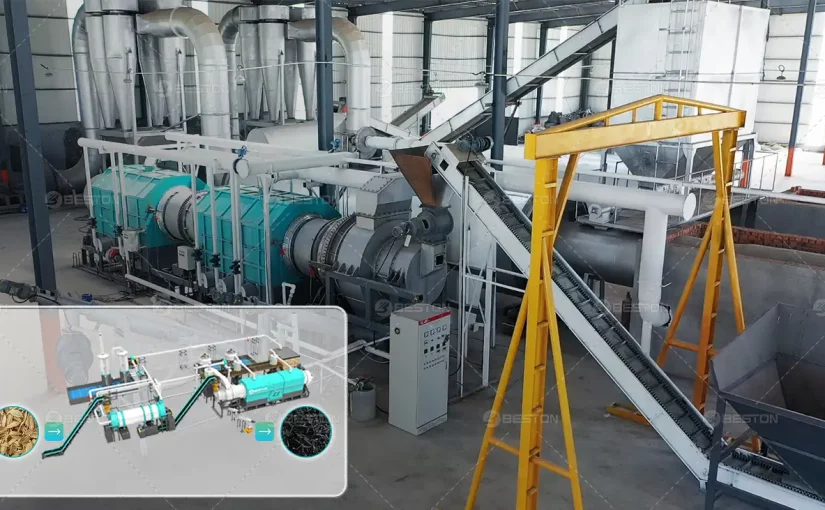
A biochar machine converts biomass into carbon-rich biochar through controlled thermal decomposition in a low-oxygen environment. However, not every type of biomass behaves identically during carbonization. Feedstock moisture, particle size, lignocellulosic composition, ash content, and bulk density can significantly affect thermal efficiency, residence time, and final biochar characteristics.
For projects evaluating a machine for making charcoal, feedstock compatibility should therefore be assessed before equipment selection. The most suitable material is generally dry, relatively uniform biomass with predictable thermal behavior.
Key Feedstock Properties for Biochar Production
Several physical and chemical parameters determine whether biomass can be processed efficiently.
| Feedstock characteristic | Recommended consideration |
|---|---|
| Moisture content | Lower moisture improves thermal efficiency |
| Particle size | Uniform particles promote consistent heat transfer |
| Ash content | Lower ash generally produces cleaner biochar |
| Bulk density | Influences feeding and reactor capacity |
| Volatile matter | Affects gas generation and carbonization behavior |
| Contaminants | Clean biomass is preferable for agricultural biochar |
Moisture is particularly consequential. Wet feedstock consumes substantial thermal energy during evaporation before carbonization begins. For many biomass carbonization systems, drying the material to below approximately 15% moisture can improve process stability.
Jute Sticks
Jute sticks are fibrous agricultural residues with substantial lignocellulosic content. A jute stick charcoal making machine can be configured for this type of biomass when the feedstock is appropriately dried and sized. The resulting biochar can be used in soil-amendment applications, provided that feedstock quality and process conditions meet the relevant project requirements.

Rice Hulls
Rice hulls present a different engineering challenge. Their high silica content contributes to elevated ash levels compared with many woody materials. A rice hull carbonizer therefore requires attention to reactor temperature, residence time, and ash handling. Despite this characteristic, rice hull biochar can have useful physical properties, including relatively high porosity.

Woody Biomass: A Stable Carbonization Feedstock
Wood chips, branches, sawdust, and other clean woody residues are among the most predictable feedstocks for biochar production. Their comparatively uniform composition makes thermal decomposition easier to control.
Particle size still matters. Oversized pieces can create uneven heating, while excessively fine material may impede airflow or feeding depending on reactor configuration. A properly designed system should match the feeding mechanism and reactor geometry to the specific biomass fraction.
Coconut Shells
Coconut shells are dense biomass with relatively high fixed-carbon potential. A coconut shell charcoal machine is therefore commonly associated with shell-based charcoal production, although process parameters must be adapted when the objective is high-quality biochar rather than conventional fuel charcoal.
Bamboo
Bamboo is another promising feedstock. Its rapid growth and fibrous structure make it suitable for thermochemical conversion. A bamboo charcoal making machine can process bamboo pieces or prepared bamboo residues, with drying and dimensional consistency remaining important factors for stable operation.
How to Match the Machine to the Feedstock
The best equipment is not necessarily the machine with the highest nominal capacity. Feedstock characteristics should determine the reactor configuration, feeding system, drying requirements, and discharge method.
Before purchasing equipment, evaluate:
- Annual feedstock availability – Estimate realistic rather than theoretical supply.
- Moisture variation – Seasonal changes can alter energy demand.
- Particle dimensions – Confirm compatibility with the feeding system.
- Ash and mineral content – Important for residue management and biochar quality.
- Desired biochar application – Soil amendment, carbon removal, or industrial use may require different specifications.
- Continuous operating requirements – Larger projects benefit from stable and predictable feedstock preparation.
Final Consideration
Feedstock compatibility is a fundamental engineering parameter in biochar production. Clean woody residues, agricultural stalks, rice hulls, coconut shells, and bamboo can all be viable, but each material imposes different requirements on drying, feeding, thermal control, and ash management.
A well-matched biochar system begins with the biomass—not the reactor capacity. Testing representative feedstock before final equipment selection can reduce operational uncertainty and provide a more reliable basis for scaling production.